

A conversation between Bill Burke, CEO of Merit Solutions, and Matt Birtwistle of Nexer
A clinical-stage therapy sponsor arrives at your facility with data, regulatory clearance, and a need for GMP-grade DNA plasmid material. They need to know when you can deliver it.
Your answer is five months.
That was the reality facing one of Merit Solutions’ CDMO customers before they invested in integrated digital infrastructure. Bill Burke, CEO of Merit Solutions, shared the story in a recent conversation with Matt Birtwistle of Nexer. The stakes extended well beyond a scheduling problem. Hundreds of DNA-based therapies are in active development, nearly all of them targeting critical patient populations where time to clinic is measured in lives, not quarters. A five-month order cycle was a commercial liability and a direct constraint on the ability of clinical partners to move their programs forward.
As Bill noted in the conversation, that cycle time was also opening the company’s market to competition.
A Supply Chain with No Margin for Error
The customer’s science was strong. Their reputation for quality was strong. Their operational infrastructure was not keeping pace with either.
Data was distributed across six or seven disconnected systems. At every handoff, information had to be re-entered manually. Every duplication created an opportunity for error. Every manual step added time. There was no integrated workflow connecting order intake to production scheduling to delivery. The five-month cycle was not a manufacturing problem. It was the accumulated cost of fragmented data architecture, the kind of architecture that most companies at that stage of growth are still running.
Two Requirements, One Threshold
The CDMO’s leadership came to Merit Solutions with two clear requirements.
First, build a digital infrastructure where data is captured once and used everywhere. Eliminate the manual re-entry and the duplication across systems. Second, get order delivery time under one month. That was both the competitive threshold and the operational requirement their clinical partners needed in order to plan development work reliably.
Merit Solutions implemented the software. Order cycle time came down to three weeks. And as Bill put it: once they got that order cycle time down and maintained their reputation for quality, they were able to gain market share.
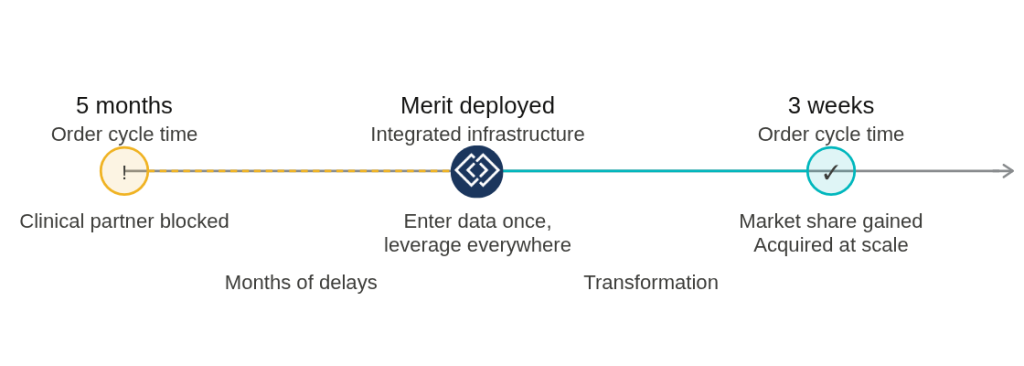
The business impact extended beyond order cycle. Early in the engagement, the customer’s leadership had identified three factors that could prevent them from reaching their long-term strategic goal. One of those three was the absence of digital infrastructure capable of supporting step-function growth. Merit addressed it. Several years later, the company was acquired by a major global biopharma organization. It became one of the headline transactions in that segment.
How “Capture Once, Use Everywhere” Actually Works
The time compression did not come from complex customization or point-to-point integration work. It came from replacing a fragmented stack of disconnected systems with a single environment where ERP, QMS, document control, batch records, and quality operations share the same data layer.
The Merit for Life Science platform is built natively on Microsoft Dynamics 365. Data is captured in a 21 CFR Part 11 controlled manner and flows through every downstream process that depends on it, without being re-keyed, reconciled, or translated across systems. When an order is entered, production scheduling, quality review, batch documentation, and compliance reporting all draw from the same record. There is no reconciliation step because there is no gap between systems that requires bridging.
That architecture is also what allows an organization to grow without adding proportional headcount, maintain a clean compliance posture through growth phases, and present a credible picture of operational maturity to acquirers, regulators, and clinical partners.
The Same Pattern Across the Industry
Matt Birtwistle described a parallel pattern from his own customer base at Nexer.
Organizations built on spreadsheets and manual processes that understand the model is not scalable but have not yet replaced it. In one case, a company needed to bring inventory management, cross-team coordination, and workflow onto a proper system across multiple geographies. The implementation required real organizational change. As Matt observed, when you are transacting in the system, it dictates what you need to do. The disciplines that a spreadsheet can quietly bypass become built-in requirements. The outcome is a business that can grow because it is no longer constrained by the bandwidth of the people manually managing the data.
In life sciences, the consequences of that constraint extend beyond the business itself. When operational fragmentation extends order lead time, it delays the clinical work that depends on those materials. The cost does not appear on a spreadsheet. It shows up in development timelines, in competitive positioning, and in the audit posture a company presents when it is ready to grow or be acquired.
The companies that break through that ceiling are the ones that treat integrated infrastructure as a strategic business investment tied directly to the milestones that matter most: clinical readouts, commercial readiness, audit posture, and acquisition readiness. In Bill’s framing, the right approach is to work backwards from those milestones and determine what digital infrastructure needs to be in place at each stage so the business does not stall out. You want to invest at the point when it is necessary to be ready, not so far in advance that capital is pulled from the science, and not so late that you hit a growth inflection without the foundation underneath you.
Talk to an expert
If your order cycle time or operational infrastructure is placing a ceiling on growth, Merit has worked through this problem with companies at multiple stages of the life sciences journey. Book a conversation with a Merit solution specialist to discuss what integrated digital infrastructure would look like for your operation.
Merit Solutions is a Microsoft partner delivering GxP-compliant ERP and QMS software built natively on Microsoft Dynamics 365, purpose-built for pharmaceutical, biotech, CDMO, and medical device manufacturers. Nexer is a global Microsoft partner with deep life sciences and regulated industry expertise. To learn more, visit the Merit for Life Science solution page.